
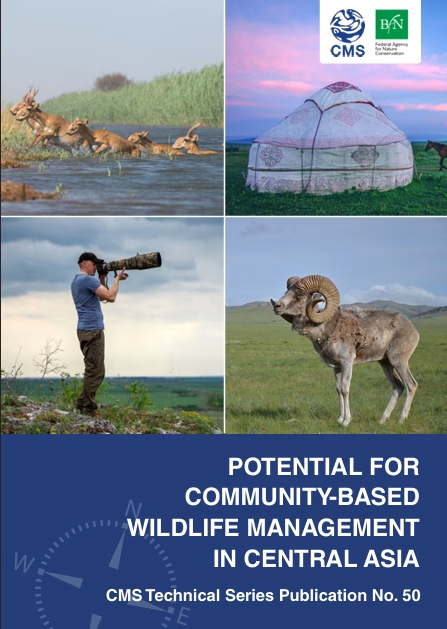
Potential for Community-based Wildlife Management in Central Asia
Community-based wildlife management (CBWM) – also referred to as Community-Based Natural Resources Management describes the management of wild living resources...
-
Publisher:Zuther, S., Michel, S., Roe, D., Kubanychbekov, Z., Karimov, Kh., Sklyarenko, S.L., Ward, S.
-
Published:30/09/2025
About The Product
Description
Rationale of this study
Community-based wildlife management (CBWM) – also referred to as Community-Based Natural Resources Management describesthe management of wild living resources – including terrestrial and aquatic wildlife, their habitats and related resources – by collective, local institutions for local benefit. A variety of other terms are used throughout literature to describe the same concept. The main objective of CBWM is to create, through a bottom-up, participatory approach, conditions allowing local people to benefit from a sustainable management and utilization of wildlife and its habitat. The approach intends to change people’s behaviours and attitudes and in doing so to achieve defined conservation goals.
Implementation of CBWM usually means granting the right to manage selected species of wildlife in a certain area to local communities, and this often includes land use rights. Thereby communities can take management decisions regarding extractive and non-extractive uses of wildlife and their habitat and about spending possible resulting revenues, e.g. on social projects. Significant conservation benefits can be achieved through such practices, provided that certain pre-conditions are met. Empowering local people to sustainably manage wildlife populations so that they become an asset to their livelihoods has contributed to a reduction of poaching and better conservation of the managed species, as documented in case studies from around the world.
To date only a few examples of CBWM exist in Central Asia. The goal of this study is to assess the potential for applying CBWM for improving the conservation of selected species of mammals listed on the Appendices of the Convention on the Conservation of Migratory Species of Wild Animals (CMS), in Central Asian countries of Kazakhstan, Kyrgyzstan, Tajikistan and Uzbekistan. . Parties to CMS, and Range States of the CMS’ Central Asian Mammals Initiative (CAMI), including the target countries of this study, adopted the Programme of Work for the initiative for 2021- 2026 (CAMI POW), which includes several activities aiming at promoting implementation of CBWM in the Central Asian region. For this purpose, four species covered under CAMI have been selected and options for CBWM approaches evaluated in terms of their feasibility. Sustainable extractive use is discussed only for species, listed on CMS Appendix II. Finally, policy recommendations to support the successful application of CBWM approaches by national Governments and other stakeholders in the region are provided.
Additional information
| Language | English |
|---|