
"Ghost of the mountain"
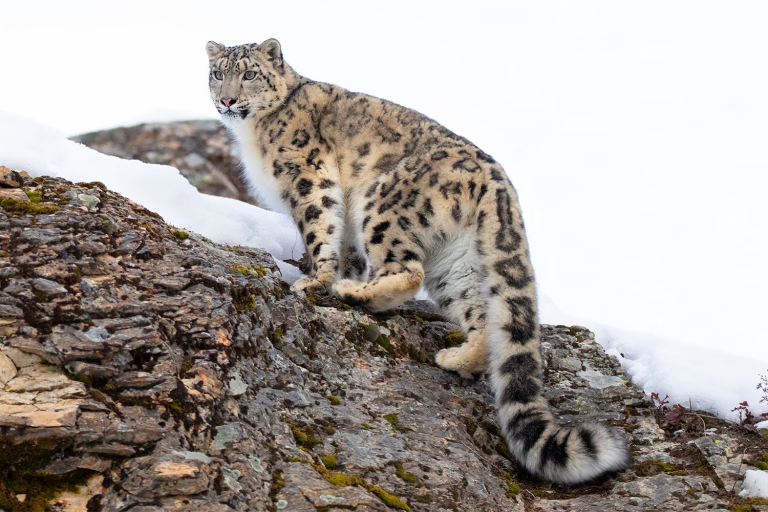
Known as the “ghost of the mountain”, this solitary, thick-furred cat is an opportunistic predator occurring in the high mountains of the Tibetan Plateau, Himalaya and other surrounding mountain ranges, including Tian Shan, Hindu Kush, Pamir, Kunlun, Altai, and Hengduan. Adapted to high altitude areas with low temperatures, their distribution coincides closely with their prey which are mainly ungulates including Asiatic ibex and argali sheep. Because of its sporadic distribution and secretive nature, the current population size of snow leopards remains uncertain. The International Union for Conservation of Nature (IUCN) has classified the species as Vulnerable with an estimated number of 3,500 – 7,500 individuals. The population is currently decreasing in some areas, and stable or slightly increasing in others. Additionally, snow leopards have been designated under Appendix I of CMS, which requires range states to take strict measures to protect them by prohibiting their removal, conserving their habitats, removing obstacles to their migration, and mitigating other threats that might endanger them, with only limited exceptions allowed. Under CITES the species is also listed under Appendix I, prohibiting all international trade for the species.
| Flagship species | IUCN Red List (2016) | KAZ Red Book (1999) | KGZ Red Book (2006) | TJK Red Book (2015) | Approx. population size in the project region |
|---|---|---|---|---|---|
| Snow Leopard Panthera uncia | Vulnerable | Listed | Listed | Listed | 152-189 (KAZ) 300-350 (KGZ) 250-280 (TJK) |
Distribution and habitat
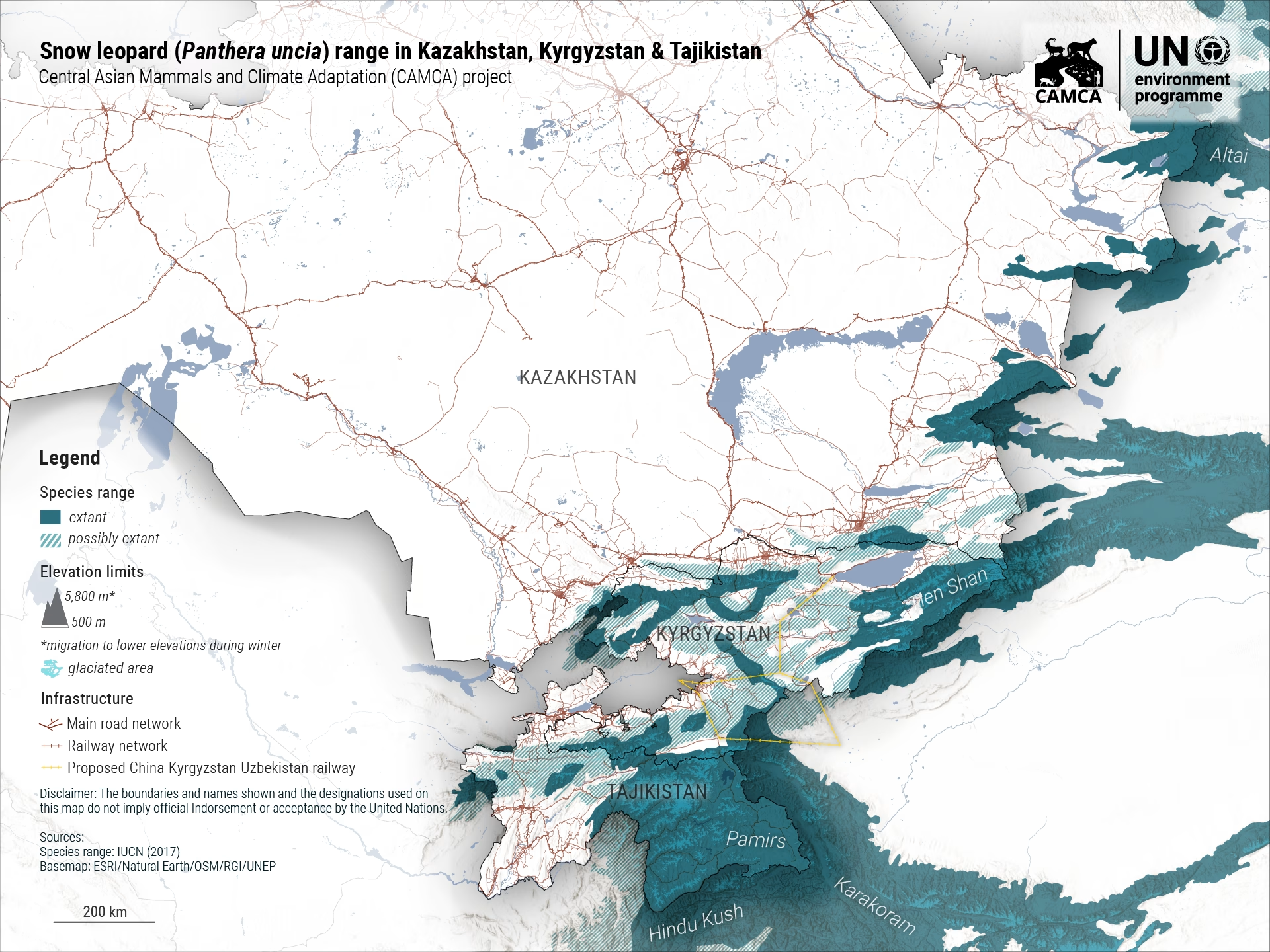
Snow leopards inhabit the mountainous regions of 12 countries in Central and South Asia: Afghanistan, Bhutan, China, India, Kazakhstan, Kyrgyzstan, Mongolia, Nepal, Pakistan, the Russian Federation, Tajikistan, and Uzbekistan. Preferring steep and highly rugged habitats with low vegetation, the snow leopard lives at elevations of below 1000 to above 5000 m. They favour rugged, steep terrain and rocky outcrops, often migrating to lower elevations during winter to avoid deep snow. As habitats become more fragmented from human activities, the remaining populations of snow leopards are decreasing, becoming more isolated and thus increasing the risk of local extinctions.
Snow leopards are found in the mountainous regions of Kazakhstan, primarily covering the Altai, Dzungar Alatau, Tarbagatai, and Tien Shan mountain ranges. Today, the snow leopard has disappeared from some peripheral ranges, and although ongoing research in Kazakhstan suggests that its population has been recovering unevenly over the past 20–30 years, it remains absent from key areas such as the Saur, Tarbagatai, Uzynkara (Ketmen), and Karatau ranges.
In Kyrgyzstan, suitable snow leopard habitat covers 89,000 km2 in the Northern, Central, Western Tien Shan and Pamir-Alai ridges. The highest densities of snow leopards are found in rugged mountainous terrain within protected areas, highlighting their importance for conservation.
Tajikistan has an 85,700 km2 habitat for snow leopards and serves as a vital corridor for the genetic interchange between southern and northern range populations. They are present in all major mountain ranges of the country with varying density dependent on terrain and presence of ungulate prey.
Importance
Within their range, snow leopards are considered a keystone species meaning that they play an important role in maintaining biological integrity in mountain ecosystems. Being a top predator with a wide range, the fate of the snow leopard depends on the populations of its prey species – wild sheep, goats, and other herbivores – and thus is considered an indicator of healthy mountain ecosystems. Measures taken to protect the snow leopard can, therefore, help protect many other species inhabiting the same area.
Threats
Snow leopards face a range of interrelated and intensifying threats across their range. Increased human activity, poaching, and competition with livestock continue to put significant pressure on both snow leopards and their prey species, particularly especially as prey populations become more fragmented and locally depleted.
POACHING: Since the mid-twentieth century, hunting has been a major driver of the decline of key prey species in Kyrgyzstan and Tajikistan, including ibex, argali, and urial, although some mountainous regions in Tajikistan have seen a notable recovery of these species, supported by the combined efforts of institutions, community-based conservancies, private hunting concessions, government agencies, and international organizations.
OVERGRAZING: Driven by rising livestock numbers and poor grazing management, degradation of alpine pastures reduces forage quality for wild ungulates, while also increasing the overlap between wildlife and livestock. This overlap raises the risk of disease transmission and, as wild prey becomes less available, leads snow leopards to prey more frequently on domestic animals, intensifying human–wildlife conflict and often resulting in retaliatory killings. At the same time, poaching for the illegal trade in fur and bones persists, and expanding infrastructure development threatens to increase habitat degradation, reduce connectivity, and restrict prey movements, further isolating already fragmented populations and heightening the risk of genetic isolation.
CLIMATE CHANGE: Existing pressures are increasingly exacerbated by climate change, as rising temperatures alter the productivity, vegetation structure, and physical conditions of alpine ecosystems, further increasing habitat degradation and uncertainty for both snow leopards and their prey
Bellamy J.J., Akhmedova T., (2020). Conservation and Sustainable Use of Pamir Alay and Tien Shan Ecosystems for Snow Leopard Protection and Sustainable Community Livelihoods. United Nations Development Programme (UNDP). Tajikistan (PIMS 5437)
J. Li, T.M. McCarthy, H. Wang, B.v. Weckworth, G.B. Schaller, C. Mishra, Z. Lu, S.R. Beissinger. Climate refugia of snow leopards in High Asia. Biol. Conserv., 203 (2016), pp. 188-196, 10.1016/j.biocon.2016.09.026
J. Li, B.V. Weckworth, T.M. McCarthy, X. Liang, Y. Liu, R. Xing, D. Li, Y. Zhang, Y. Xue, R. Jackson, L. Xiao, C. Cheng, S. Li, F. Xu, M. Ma, X. Yang, K. Diao, Y. Gao, D. Song, K. Nowell, B. He, Y. Li, K. McCarthy, M.Y. Paltsyn, K. Sharma, C. Mishra, G.B. Schaller, Z. Lu, S.R. Beissinger. Defining priorities for global snow leopard conservation landscapes. Biol. Conserv., 241 (2020), Article 108387
Li, X.; Ma, L.; Hu, D.; Ma, D.; Li, R.; Sun, Y.; Gao, E. Potential Range Shift of Snow Leopard in Future Climate Change Scenarios. Sustainability 2022, 14, 1115. https://doi.org/10.3390/su14031115
W. Rashid, J. Shi, I. ur Rahim, H. Sultan, S. Dong, L. Ahmad. Research trends and management options in human-snow leopard conflict. Biol. Conserv., 242 (2020), Article 108413, 10.1016/j.biocon.2020.108413
Sharief A, Kumar V, Singh H, Mukherjee T, Dutta R, Joshi BD, et al. (2022) Landscape use and co-occurrence pattern of snow leopard (Panthera uncia) and its prey species in the fragile ecosystem of Spiti Valley, Himachal Pradesh. PLoS ONE 17(7): e0271556. https://doi.org/10.1371/journal.pone.0271556
Snow Leopard Working Secretariat. 2013. Global Snow Leopard and Ecosystem Protection Program Bishkek, Kyrgyz Republic.
Snow Leopard Working Secretariat. 2020. Global Snow Leopard and Ecosystem Protection Program ,Country Updates 2020, Kyrgyz Republic.
Uncia uncia | CMS – https://www.cms.int/en/species/uncia-uncia
https://www.iucnredlist.org/species/22732/50664030
Grachev, A. (2026). Snow Leopard (Panthera uncia) Status in Kazakhstan. Snow Leopard Reports, 5(1). https://doi.org/10.56510/slr.v5.63867
Kachel , S., Shokirov, Q., Kholmatov, I., Mirzoev, M., & Saidov, A. (2026). Snow Leopard (Panthera uncia) Status in Tajikistan. Snow Leopard Reports, 5(1). https://doi.org/10.56510/slr.v5.63876
Kubanychbekov, Z., Sharma, K., Zhumabai uulu, K., Wearn, O., Durbach, I., Raulerson, M., … Eldiiar, K. (2026). Snow Leopard (Panthera uncia) Status in Kyrgyzstan. Snow Leopard Reports, 5(1). https://doi.org/10.56510/slr.v5.63883