
The Tarim red deer
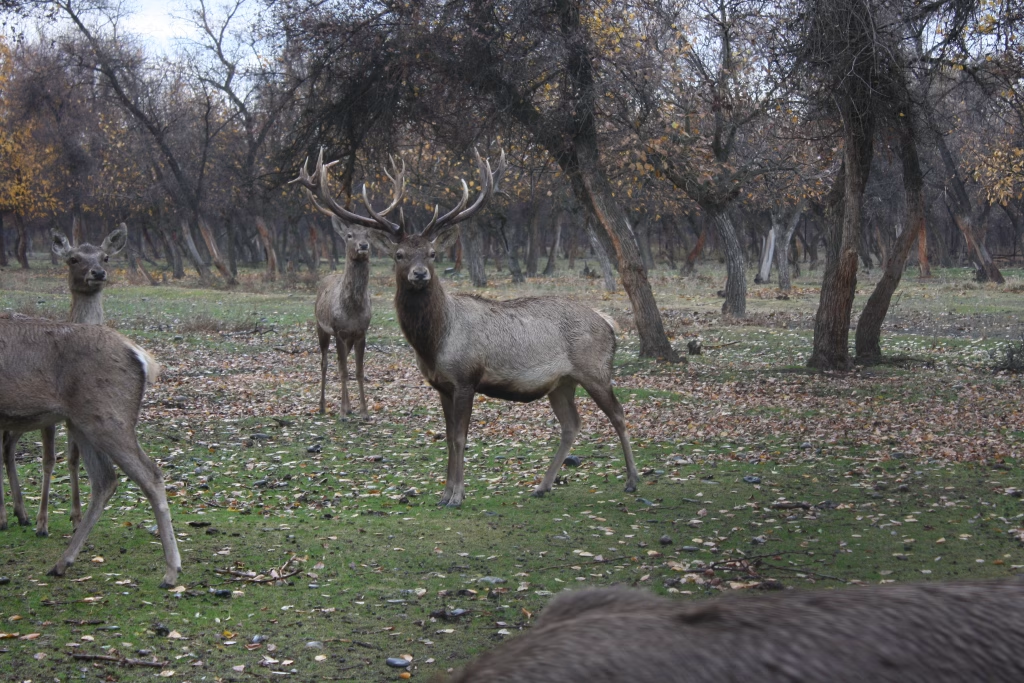
The Tarim red deer, Cervus hangul, is found in riparian regions of Central Asia, western China, and mountainous areas of northern India. The Bukhara deer is a subspecies of Tarim red deer. They live in sexually segregated herds except during the breeding season. The males are considerably larger than the females and grow a full rack of antlers which are used to compete for females during mating season, or rut. After the rut, the antlers are shed and will regrow in the following breeding season. Due to anthropogenic threats, the number of Bukhara deer decreased in the 1960s, becoming restricted to a few nature reserves and locally extinct in many other areas of their former range. After several conservation actions, including reintroductions and introduction into suitable habitats, the population increased to an estimated 3,735 – 3,900 in 2020 (including semi-wild animals in large enclosures). The Tarim red deer species as a whole is designated as Least Concern on the IUCN Red List due to the recovery of Bukhara deer, although this subspecies has not been separately evaluated. However, the CMS have listed the Bukhara Deer in both Appendix I and II, covering species with a risk of extinction within parts of their range and with unfavourable conservation status to encourage global or regional conservation agreements. In CITES, the species is listed under Appendix II, where international trade of the species is controlled.
| Flagship species | IUCN Red List (2017) | KAZ Red Book (1999) | KGZ Red Book (2006) | TJK Red Book (2015) | Approx. population size in the project region |
|---|---|---|---|---|---|
| Bukhara deer Cervus hanglu bactrianus | Least Concern | Listed | N/A | Listed | 520-650 (TJK) 1,100 (KAZ) |
Distribution and habitat
The Bukhara deer includes populations occurring in Afghanistan, Kazakhstan, Tajikistan, Turkmenistan, and Uzbekistan. The highest number are found in Uzbekistan where they are transboundary with Turkmenistan. After reintroduction in Kazakhstan, the species is found in the Karatchingil hunting concession, the Altyn-Emel National Park, and the Turkestan region. The primary population of Bukhara Deer in Tajikistan is in the Tigrovaja balka sanctuary, riparian forests along the Pyandj River, and border areas with Afghanistan. Smaller populations of Bukhara Deer are also present in the zakazniks of Dashti Jum, Sarikhosor, and Zeravshanskiy.
It predominantly inhabits riverbanks and floodplains with riparian forests. When the habitat conditions are the Bukhara deer remains within defined areas and does not range over great distances. However, during environmental conditions such as droughts and floods over, it is forced to migrate in search of better habitat.

Importance
Bukhara deer are the largest herbivores in their ecosystems and have a profound effect on vegetation dynamics, as well as on other ecosystem components. Through selective grazing, browsing, and debarking, they affect plant growth, species composition, and vegetation structure. They disperse plant seeds in their fur and through their excrement, and create specific conditions for seed germination by causing local concentrations of nutrients in form of manure and carcasses. Historically the Bukhara have been an important prey of large carnivores, in particular the now extinct Turan tiger Panthera tigris tulliana.
Threats
Despite many successful conservation actions, the Bukhara deer is still vulnerable to threats such as poaching, illegal trade and habitat degradation.
POACHING: Both in the past and present, poaching continues to be a significant pressure contributing tothe decline in Bukhara deer populations. Illegal killing may also occur in response to real or perceived crop damage, and in areas with higher hunting pressure, deer exhibit behavioral changes such as increased nocturnality and avoidance of open habitats.
HABITAT FRAGMENTATION & COMPETITION: Like many other ungulates in Central Asia, competition with livestock for grazing grounds, together with the associated risk of disease transmission, is a significant threat to Bukhara deer. This is exacerbated by limited availability of suitable habitats and increasing wildlife interaction with humans and livestock. Habitat fragmentation, as well as barriers such as fences and roads, limit the movement of the deer posing a risk of inbreeding among disconnected deer populations and lowering genetic variation.
HABITAT LOSS: Habitat loss and degradation is recognised as some of the most critical threats to the Bukhara deer. The tugai forest is a critical habitat for the deer. This type of forest was once a widespread ecosystem in the floodplains and valleys of the arid regions in Central Asia. Conversion of land for agriculture, urban expansion, deforestation, and grazing have all contributed to the loss of these habitats. In addition, large-scale hydrological alterations, including dams, reservoirs, and water withdrawal for irrigation, have altered natural river dynamics, reducing seasonal flooding and groundwater levels essential for tugai regeneration. Climate change further exacerbates these pressures by intensifying water scarcity. In some protected areas, growing deer populations can locally exceed habitat carrying capacity, leading to additional degradation.
Brook, S.M., Donnithorne-Tait, D., Lorenzini, R., Lovari, S., Masseti, M., Pereladova, O., Ahmad, K. & Thakur, M. 2017. Cervus hanglu (amended version of 2017 assessment). The IUCN Red List of Threatened Species 2017: e.T4261A120733024. https://dx.doi.org/10.2305/IUCN.UK.2017-3.RLTS.T4261A120733024.en. Accessed on 31 October 2022.
Frank, D. A. (1998). Ungulate regulation of ecosystem processes in Yellowstone National Park: Direct and feedback effects. Wildlife Society Bulletin, 26(3), 410-418.
Karlstetter, M., Mallon, D. 2014. Assessment of gaps and needs in migratory mammal conservation in Central Asia. Report prepared for the Convention on the Conservation of Migratory Species of Wild Animals (CMS) and the Deutsche Gesellschaft für Internationale Zusammenarbeit (GIZ) GmbH. Financed by the Ecosystem Restoration in Central Asia (ERCA) component of the European Union Forest and Biodiversity Governance Including Environmental Monitoring Project (FLERMONECA).
Cervus elaphus yarkandensis | CMS
Saidov N.Sh. 2011. National Report of the Republic of Tajikistan on conservation and restoration of the Bukhara Deer (Cervus elaphus bactrianus). CMS Secretariat. https://www.cms.int/bukhara-deer/sites/default/files/document/BKD1_Inf_04_1_National_Report_Tajikistan_E_0.pdf