
A relative of the red deer
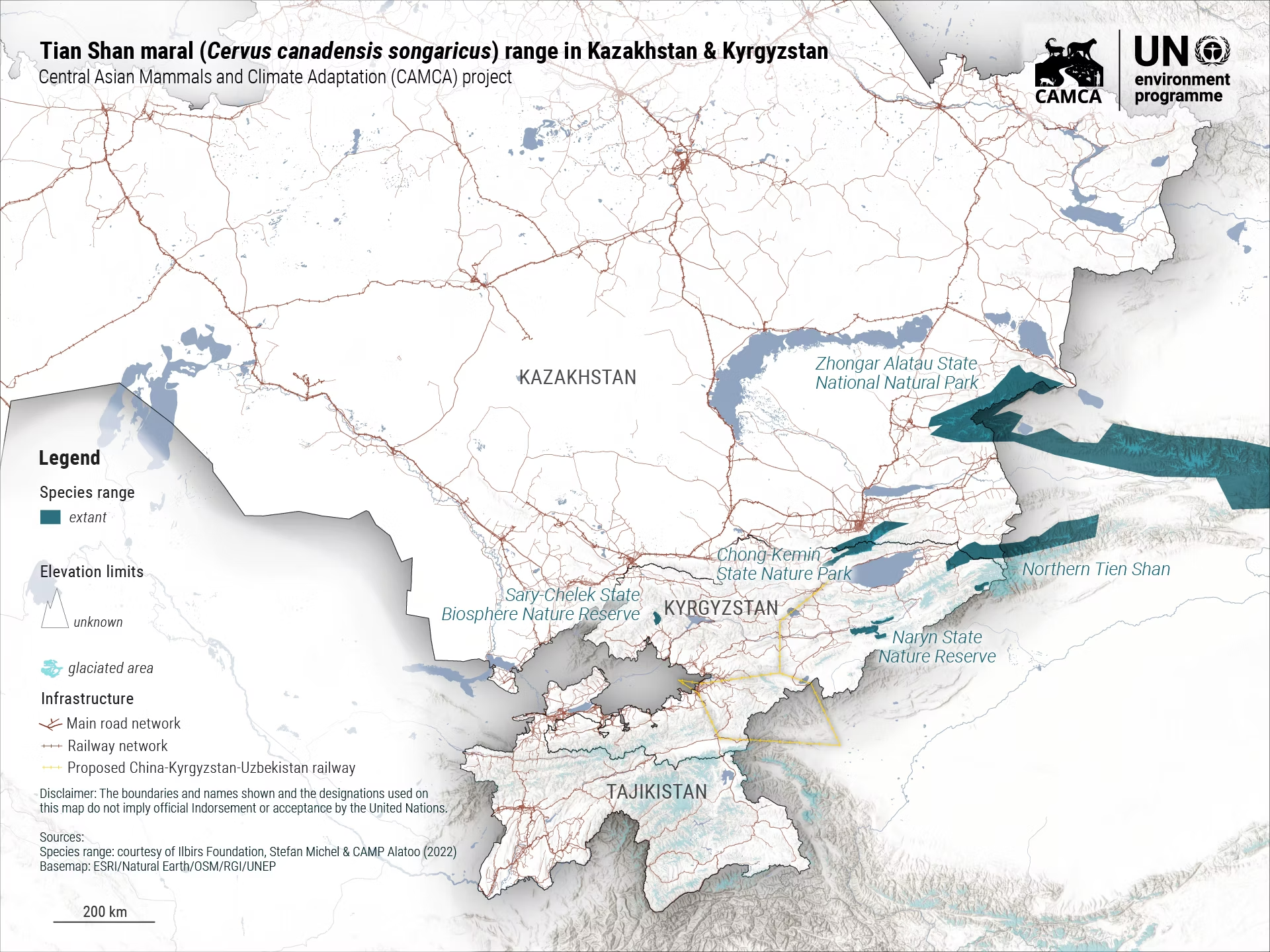
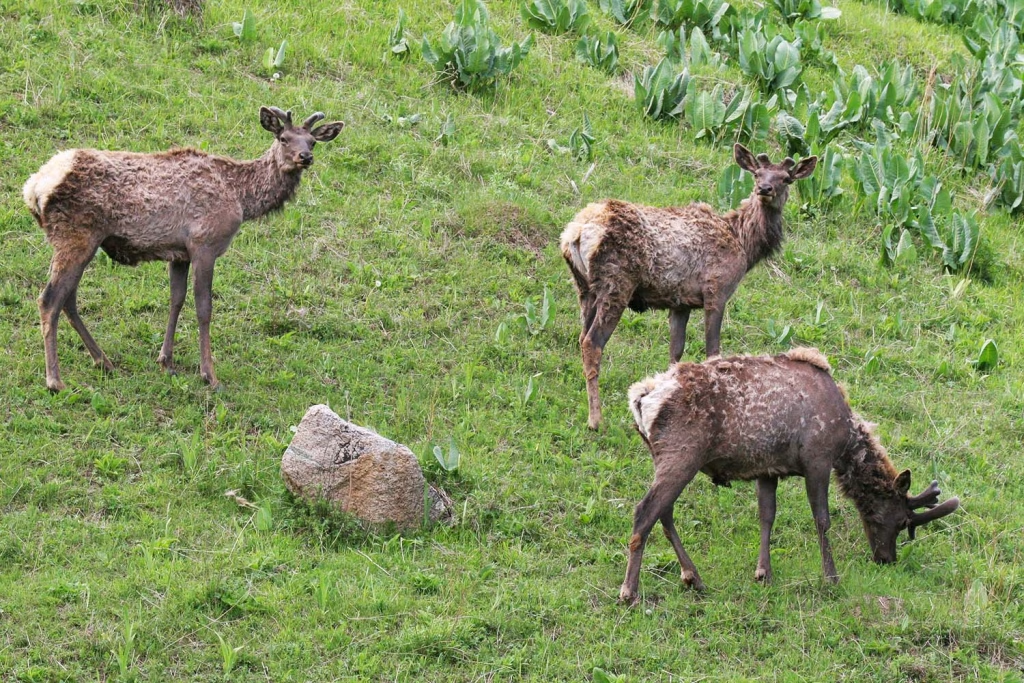
The Tien-Shan maral is a Central Asian mountain deer that can be found in mountainous landscapes. It uses forested, semi-open, and open mountain habitats, moving seasonally between summer and winter ranges in response to forage, temperature, and snow conditions. Although the species has previously been widely distributed, the Maral has disappeared from much of its former range and now persists in small, isolated populations, with important strongholds in areas such as the Naryn region of Kyrgyzstan. In Kazakhstan, there is no full population estimate, although about 1,700 maral were recorded in Dzungar-Alatau National Park in 2021. A 2024 survey, led by the Ilbirs Foundation, assessed the distribution and population size of the maral in Kyrgyzstan, specifically in the Naryn State Nature Reserve, Salkyn-Tör State Nature Park and nearby areas. In total, 160 individuals were recorded, giving estimates of approximately 400-600 individuals in the Naryn River valley and its tributaries. The Tian Shan maral is a subspecies of wapiti, Cervus canadensis. This relative of the red deer is distributed through North America, Siberia, and in the high mountains of Central Asia. During the rut, the Maral males grow large antlers and advertise with a loud bugling call designed to carry over long distances. Maral, or wapiti, are listed as Least Concern in the IUCN Red List, but the Tien Shan maral subspecies has not been evaluated and may be more threatened.
| Flagship species | IUCN Red List (2015) | KAZ Red Book (1999) | KGZ Red Book (2006) | TJK Red Book (2015) | Approx. population size in the project region |
|---|---|---|---|---|---|
| Tien Shan Maral Cervus canadensis songaricus | Least Concern | Not listed | Listed | N/A | 1,700 (KAZ) 800 (KGZ) |
Distribution and habitat
Historically, the Tien-Shan maral occurred across parts of present-day Kyrgyzstan, Kazakhstan, Uzbekistan, Tajikistan and possibly western China, including the Dzungarian Alatau, the Tien-Shan mountain system, the northern margins of the Fergana Basin, the northeastern spurs of the Alay Range and possibly the Syrdarya Karatau Range. Today, the species occupies only a small part of its former range. Its current distribution consists of several isolated areas in the Tien-Shan of Kyrgyzstan and Kazakhstan, as well as the Dzungarian Alatau. Maral occurring further North in Kazakhstan are Siberian or Altai maral and may represent a separate subspecies. In Kyrgyzstan, the species had disappeared from most of its former range by 1980, except for the eastern part of the Naryn-Too Range. In Kemin Valley and eastern Ysyk-Köl, maral were previously considered extinct, but since 2010 the species has recolonised these areas from Kazakhstan, forming transboundary populations. In Jalal-Abad Region, non-native maral from the Altai region have been introduced.
During summer months, the marai spends time in alpine meadows, while in winter it moves into valleys. Seasonal migration may be as much as 140 km in the Altai and Sayan Mountains. Tian Shan maral mainly inhabit coniferous and mixed tree forests, which may be an adaptive behaviour to poaching pressure. Other maral or wapiti species prefer grasslands above the forest belt as summer habitat and riparian areas as well as semi-desert, steppe and shrubland on sites with little snow as winter habitat.
Importance
Grazing animals have an important role within ecosystems by maintaining vegetation structures. Cyclic grazing ensures that vegetation growth is controlled while also providing important ecosystem processes, such as increasing nitrogen availability for plants. When large herbivores roam the landscape they transport seeds through their fur and excrement, as well as leaving nutrient hotspots for vegetation growth in the form of carcasses. A decrease in grazing animals within an ecosystem could lead to changes in vegetation structure and species composition, ultimately changing the ecosystem. The preference of the maral for forests, as observed in Central Asia and likely caused by poaching, may affect the natural rejuvenation of these forests and contribute to their degradation. Maral are also an important prey species for predators such as snow leopards, brown bears, and wolves.
Threats
POACHING: The main threat to Tien-Shan maral in Kazakhstan and Kyrgyzstan is poaching, which reduces population size and, due to behavioural responses to human disturbance, large sections of suitable habitat are not used, hindering connectivity between populations.
PASTURE COMPETITION: Other major pressures include livestock grazing, pasture expansion, and disturbance from herders and dogs. While livestock numbers are increasing, forage competition increases and reduces available habitat. Livestock also threatens the species through vector-borne diseases.
GENETIC POLLUTION: Genetic pollution is also a threat to the species, such as the release of maral originating from Siberian Altai or through hybridization with other deer species, such as spotted deer Cervus nippon and European red deer Cervus elaphus, may be a risk if these species are kept together in deer farms or are released for hunting purposes into natural habitats.
CLIMATE CHANGE: The Tian Shan maral is affected by seasonal variations in temperature and precipitation and extreme climatic conditions. Changes in the rate of precipitation cause alterations in wet and dry periods and may lead to low resource availability, resulting in weight loss or forcing the animals to migrate. They can also be affected by increasingly extreme climatic conditions such as severe cold or droughts, which limit forage availability and accessibility. Likewise, certain parasites, such as horse flies, are more active during warm periods.
Mattioli, S. 2011. Family Cervidae (Deer). In: D.E. Wilson and R.A Mittermeier (eds), Handbook of the mammals of the world, pp. 350-443. Lynx Edicions, Barcelona.
Dangal, S. R. S., Tian, H., Lu, C., Ren, W., Pan, S., Yang, J., … Hessl, A. (2017). Integrating herbivore population dynamics into a global land biosphere model: Plugging animals into the earth system. Journal of Advances in Modeling Earth Systems, 9, 2920– 2945. https://doi.org/10.1002/2016MS000904
Brook, S.M., Pluháček, J., Lorenzini, R., Lovari, S., Masseti, M., Pereladova, O. & Mattioli, S. 2018. Cervus canadensis (errata version published in 2019). The IUCN Red List of Threatened Species 2018: e.T55997823A142396828. https://dx.doi.org/10.2305/IUCN.UK.2018-2.RLTS.T55997823A142396828.en. Accessed on 03 November 2022.