
One of the world’s most widely distributed terrestrial mammals
The range of the omnivorous brown bear, Ursus arctos, has declined in North America, Europe, and Asia, and the species has been extirpated in North Africa. However, it remains widespread across three continents and is still one of the world’s most widely distributed terrestrial mammal. Globally the population remains large and is not significantly declining and may even be increasing in some areas.
There are many small, isolated subpopulations that are at risk of extinction, but others, under more protection and management, are expanding. Isolated brown bear populations in Kazakhstan, Kyrgyzstan and Tajikistan are categorized as Vulnerable or Endangered by the IUCN red list. The species are also listed under Appendix I in CMS, covering species with a risk of extinction within their range. Additionally, the bear is listed under CITES Appendix I (Bhutan, China, Mexico and Mongolia), covering endangered species where international trade is prohibited, and Appendix II (except Bhutan, China, Mexico and Mongolia), where international trade is controlled.
| Flagship species | IUCN Red List (2015) | KAZ Red Book (1999) | KGZ Red Book (2006) | TJK Red Book (2015) | Approx. population size in the project region |
|---|---|---|---|---|---|
| Tien Shan Brown Bear Ursus arctos isabellinus | Least Concern | Listed | Listed | Listed | 195-255 (KAZ) 612 (KGZ) 550-600 (TJK) |
Distribution and habitat
Brown Bears occupy a great variety of habitats from dry Asian steppes to Arctic shrublands to temperate rain forests. Their range overlaps that of both the American black bear Ursus americanus and Asiatic black bear U. thibetanus, and also slightly that of the Polar Bear U. maritimus. In terms of elevation, they range from sea level to 5,000 m. They occupy a greater diversity of habitats than any other species of bear and also exploit a large variety of food items, including nuts, berries, plant roots and shoots, mammals, and fish.
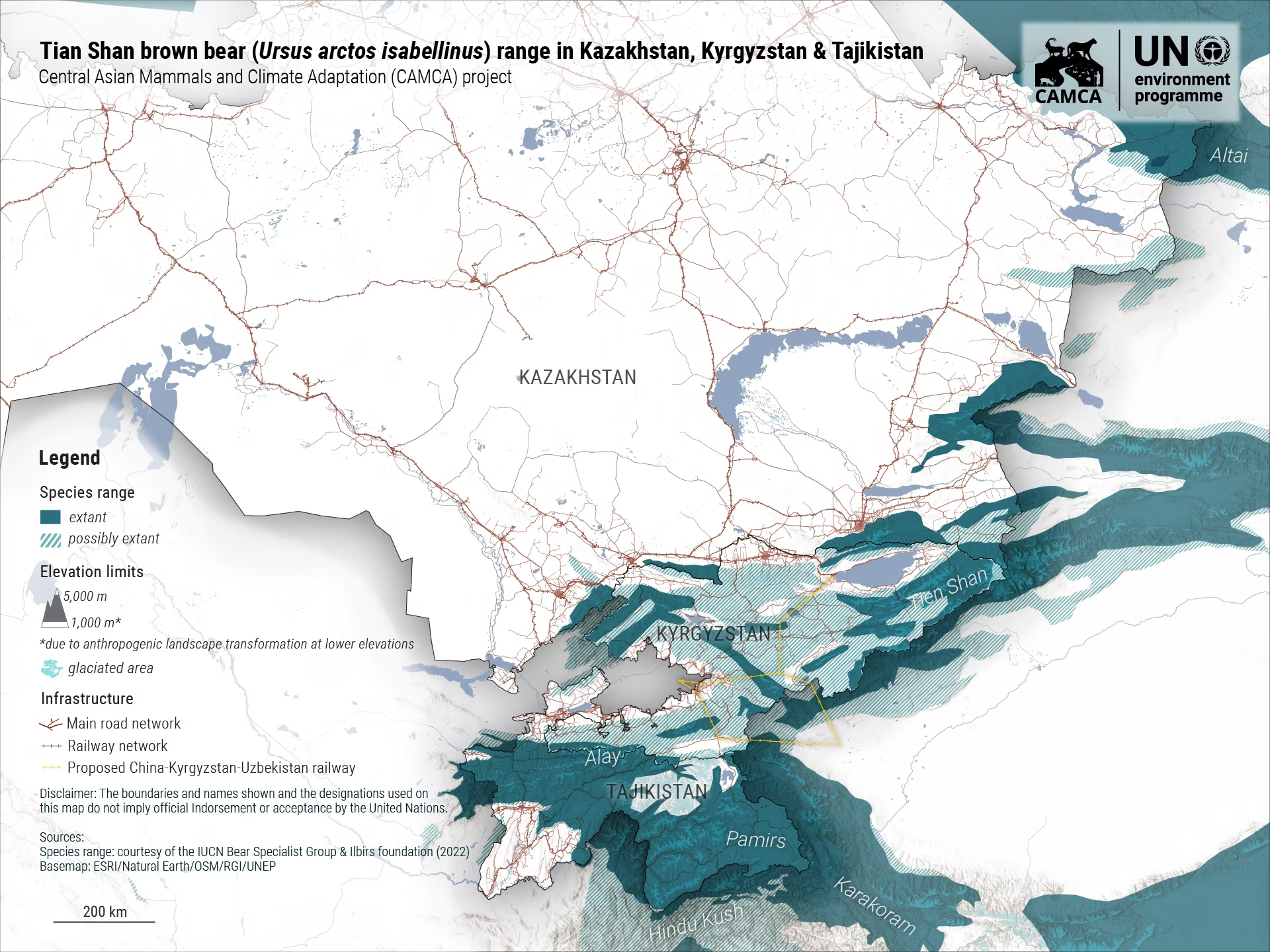
In Kazakhstan, Kyrgyzstan, and Tajikistan, the Tian Shan brown bear, Ursus arctos isabellinus, a subspecies of brown bear, is broadly distributed across the region. This bear inhabits lowlands and highlands from the elevation of 1000 m to 4700 m. There are almost no bears present in areas below 1000 m due to extreme anthropogenic transformation of the landscape. There are also no bears over 5000 m due to a lack of food sources. Analysis shows that the density of bears varies depending on the elevation and habitat characteristics in Kazakhstan, Kyrgyzstan, and Tajikistan. In Tajikistan, the highest density is found in the Hissar-Alay mountain system and the lowest density in the Western and Central Pamir mountains. Small populations are found on the high plateau of the Eastern Pamirs. In Kyrgyzstan, the highest density of brown bear inhabits the Central, Inner and West Tian-Shan and a smaller number is found in other mountains of Kyrgyzstan. In Kazakhstan, this brown bear occurs in the West and North Tian-Shan but has disappeared from the Karatau range. It also inhabits the Zhongar Alatau mountains. The brown bears of Northern Kazakhstan and the Altai mountains do not belong to this subspecies.
Importance
Bears play a role in fertilizing forests by depositing scat on the forest floor. A single brown bear scat may contain tens of thousands of seeds that remain viable and can readily germinate. These seeds are then dispersed at finer spatial scales by scatter-hoarding rodents, animals that store food in several different locations in their territory. This can potentially increase seedling recruitment success and colonize a greater number of microsites. The seeds that remain in bear scat are fertilized by the fecal material, which may increase germination and seedling growth rates.
Bears also help to clean up carcasses and, as predators, they help keep populations of ungulates in balance. Finally, bears are also important as an indicator species. Bears require a variety of habitats to survive and thus managing habitat for bears benefits many other species.

Threats
HUMAN-WILDLIFE CONFLICT: Bears are attracted to easily accessible food sources, including livestock, orchards, beehives, and unmanaged waste, bringing them into close contact with humans. Although attacks on people are rare, such encounters can be dangerous and often result in bears being killed. Livestock depredation and crop raiding create economic losses for local communities, leading to retaliatory killings and negative perceptions of bears. These issues are often exacerbated by poor management practices, including inadequate livestock protection and insufficient measures to prevent bears from accessing human-related food sources. Bears are also killed both in retaliation for damage and for their economic value, as their fat and body parts are used in traditional medicine, and their meat is considered a delicacy in some areas. In addition, bears are sometimes hunted for sport, and cubs may be captured and kept in captivity after adult females are killed.
In the last decades in Kazakhstan, Kyrgyzstan, and Tajikistan, the bear population has been able to recover in many places benefiting from abandonment of remote hamlets and resulting easier access to semi-wild orchards with fruit and nut trees. However, this has also led to conflict in some villages who depend on the same resources and thus bears are seen as competitors.
CLIMATE CHANGE: The impact of climate change on brown bears in Kazakhstan, Kyrgyzstan, and Tajikistan has not yet been studied. The temperature change will inevitably lead to challenging impacts on important food items that brown bears depend on. Generally, brown bears may be able to adapt to climate change. However, smaller and isolated populations could become more vulnerable, especially if they depend on food sources that are likely to be impacted by climate change (e.g, marmots in the Eastern Pamirs or highlands of Hissar-Alay Mountain system or important fruit-bearing vegetation). Climate change may also affect the distribution patterns of bear populations, as well as affect their biology, especially hibernation patterns, with possible mismatches between periods of particular need and periods of availability of food sources. Climate change could also compound other more pressing threats, including direct persecution by humans, which is considered a key threat responsible for the decline in bears in some parts of Tajikistan.
- 2017 – Least Concern (LC), but Tien Shan population Vulnerable (VU) http://dx.doi.org/10.2305/IUCN.UK.2017-1.RLTS.T41688A114261661.en
- 2016 – Least Concern (LC) http://dx.doi.org/10.2305/IUCN.UK.2016-3.RLTS.T41688A45034772.en
- 2008 – Least Concern (LC) http://dx.doi.org/10.2305/IUCN.UK.2008.RLTS.T41688A10513490.en 1996 – Lower Risk/least concern (LR/lc)
- The IUCN RED LIST OF TREATENED SPECIES – Supplementary_Information_121229971
- McLellan, B.N., Proctor, M.F., Huber, D. & Michel, S. 2017. Ursus arctos. The IUCN Red List of Threatened Species 2017: e.T41688A121229971. http://dx.doi.org/10.2305/IUCN.UK.2017- 3.RLTS.T41688A121229971.en
- Data of the Department of Biodiversity Conservation of Protected Areas on the number of red-listed animals, inhabiting in the Kyrgyz Republic for 2021
- Sawaya, Ramsey, & Ramsey, 2017
- Mammals of the Soviet Union, 1967
- Red data Book Kyrgyz Republic, 2007
- Mammals of the Kyrgyz Republic 1972